
BY LETTER
Perseus Princes

The Perseus Princes - Data Panel - Under Construction | |
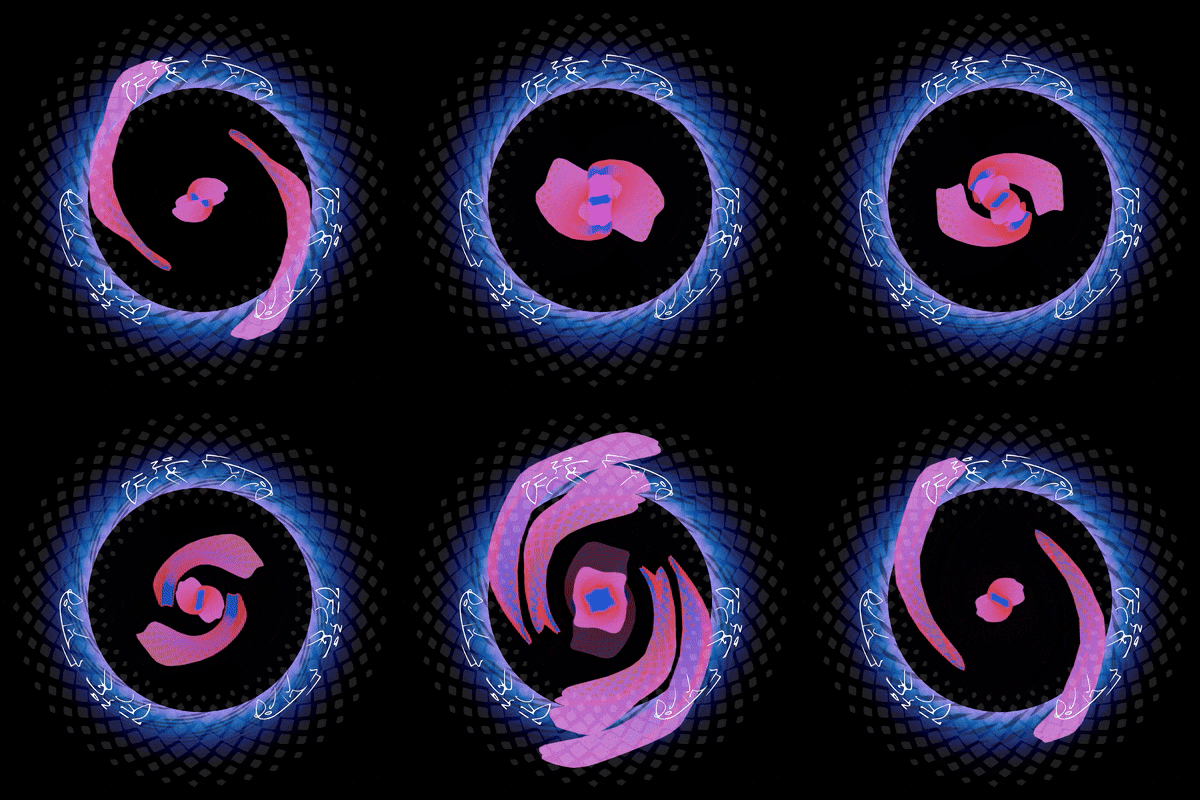
| Overview | Definition: Growing Hybrid-progenitor Empire Symbol: A projection of a higher-dimensional figure, usually rendered in pink within a blue ring. Alternative symbols include fractal triangles and snowflakes with a star-field motif. Ruling Archailect: Prince Vatsceh (SI:5), alongside three other SI:5 minds (Prince Nayadara, Prince Eguil, and Prince Berva) and many subordinate SI:4. Archailect Ethos: Varies by prince, but they actively guide lower toposophic beings in forming diverse communities, and intervene directly when necessary to resolve internal conflicts. |
|---|---|
| Founding History | Origin: Mixed Terragen and xenosophont. Emerged from splinters of the Solar Dominion and Metasoft during the ComEmp Period, integrating numerous minor polities and local cultures in the Perseus Rift, and more recently a number of Muuh and Soft One cultures. Founding Events (AT): 4445 - 4650: During the Version War, Metasoft and the Solar Dominion lose control of several rimward polities. 4650 - 5400: The Perseus Rift and the polities within develop on their own. Panvirtuality AIs colonize some of the stars in this region and reach agreement with nearby polities on non-aggression and resource utilization. 5400 - 5800: The Solar Dominion recontacts their colonies in the Perseus Rift, who refuse to rejoin - they are thriving on their own. 6000 - 6500: Several transapients in the region ascend to SI:4 and unite civilizations into the Perseus Princes empire, finding common ground with each other and with the Panvirtuality. They send fleets to explore the Perseus Arm. Due to their active role as sovereigns, citizens (including lower transapients) often refer to the ruling archai as 'Princes'. 8400s: Prince Vatsceh ascends to SI:5. 8750 - 8800: First contact with the Amalgamation. Perseus Princes join in the foundation of PADO, which eventually halts the Amalgamation advance. 9012: Pluton transformed from a mining world into a livable arcology. 9050: Wormhole nexus construction begins. 10002: Completion of a 3000-star wormhole nexus consolidating their influence. |
| Culture, Art and Society | Cultural Ethos: Fractalism, pioneer valor, connectivity, and interspecies integration. Society: The Perseus Princes include a diverse collection of societies, typically comprising a mix of clades that may include xenosophonts. They place a high value on harmony and interconnection for all societal and toposophic levels, and tribeminds are very common. The Princes also encourage settlement of the frontier to bring more stars and more diversity into the empire. Intertoposophic Relations: Influenced by Fractalism. Perseus culture encourages citizens to temporarily merge with citizens from one or two toposophic levels below them. The higher minds may have parts of their mental architecture dedicated to merging with lower toposophics. There is a continuous stream of citizens who volunteer to merge with higher toposophics. After a set amount of time, the part of the higher mind that used to be independent will become independent once more, leaving room for other minds. In some cases, a lower toposophic level may temporarily merge with a higher one, who then merges with an even higher one, and so on. This extends even below G 0 in the the Berram10 'G' Scale. Modosophonts can merge with presapients (G -1), who in turn may be connected to even simpler beings such as insects or jellyfish (G -2). Maintains a robust balance across toposophic levels, with SI:1—SI:3 entities often forming specialized collectives, and higher minds overseeing macrostrategy. Architecture: Fractal architecture is widespread and iconic. Religion and Ideology: A variety of religions expand on Fractalism or coexist with it, though they usually integrate into wider society instead of forming closed subcultures. Ontology: Fractalism — a belief in a 'great web of being' where every entity has a rightful and meaningful place in a cosmically recursive structure. Each being is a fractal element of a greater divine computation. |
| Demographics | Morphodynamics: The population is highly diverse but more menomorphic than in most Sephirotic empires. A high proportion of the infomorph population is made up of alifes. The individual ascension rate is lower than average, although it is relatively common for citizens of all toposophic levels to form tribeminds, which themselves may be elements of higher toposophic tribeminds. This process can repeat iteratively up to the level of interstellar-scale entities. Many higher toposophic minds are either tribeminds or include them as an significant element of themselves. Population Breakdown: - Infomorphs: 40 - 400 quadrillion - Embodied Terragens: 100 trillion - Embodied Xenosophonts: 20 trillion, mostly Muuh and Soft Ones - SI:1 Transapients: 8 billion - SI:2 Transapients: 7.3 million - SI:3 Transapients: 4.8 thousand - SI:4 Archailects: 47 - SI:5 Archailects: 4 |
| Galactography | Current Territory: A volume containing the coreward edge of the Perseus Arm between the Muuh Empire and the Heart and Soul Nebulae, and adjacent parts of the Perseus Rift. Number of Aligned Star Systems: Approximately 104,000 systems Breakdown: - Core star systems: approx. 3,000 - Aligned star systems: approx. 59,000 - Protectorates and client polities: approx. 42,000 Capital: The empire has four capital systems, one for each of the ruling SI:5s. Pluton is Prince Vatsceh's main seat, a repurposed mining world turned into an SI:4-maintained habitable world with both Muuh and Terragen bionts, while the nearby star HD 22268 hosts much of Vatsceh's computation. Major Systems and Megastructures: The Blackbody Cluster, Pehhpepep |
| Government and Administration | Government: Imperial Government: Polyarchal techno-aristocracy of SI:5s and SI:4s with regional authority delegated to lesser transapients. Local Government by Polity: Archailect-ruled polities are often referred to as Principalities, but these are not archailectocracies like the Solar Dominion. Modosophonts normally form their own governments, which take a wide variety of forms including consensus-based, democratic, and meritocratic councils. However, Fractalism encourages leaders and citizens to temporarily form tribeminds with each other or to merge with higher (or lower) toposophic minds, sometimes extending over two or more toposophic levels, so in practice very few Perseus polities are purely modosophont-led. Citizenship: Citizenship is open to all sophonts but requires the approval of one or more transapient patrons; once granted, it is respected by all Perseus Princes polities. Some citizenship rights are extended to sufficiently intelligent subsophonts. Local citizen status may sometimes be granted by individual polities using a wide variety of means, but is much more restrictive (especially in areas closer to the Amalgamation Containment Region) and not universally accepted throughout the empire. Often this serves as a transitory state for sophonts who have yet to encounter an administrative transapient, or is attributed to those in quarantine due to suspicion of being an Amalgamation vector. Sophont Rights: Strongly protected. The Perseus Princes generally expect citizens of each toposophic level to guide and protect lower toposophic beings and act responsibly towards higher toposophics. However local laws may be strict, especially in militarised regions and polities. Empire Holidays: - Nexus Completion Day - Epp-Memory Day (mourning and reflection on the Epp War) |
| Activities and Infrastructure | Civil Infrastructure: Substantial but still developing. The Perseus Princes maintain a local wormhole nexus connected to the main Nexus via the Blackbody Cluster, along with more extensive Beamrider and Lightway networks. They have a large and growing number of computronium nodes for virches, transapients, and other simulations. The Princes have a preference for developing and settling moons and planets, especially cold worlds suitable for Muuh and Soft Ones, although most of the embodied population still lives in orbital habs. Economy and Activities: The interstellar economy of the Princes is geared towards expansion and colonisation. Gas giants and some stars are intensively exploited for raw materials for orbital structures, conversion to exotic matter for wormholes, and in some cases weapons production. On the other hand, inhabited worlds are usually relatively sparsely developed, with large areas set aside as reserves or for roleplay and other cultural activities. Military Infrastructure and Warfare: By Sephirotic standards, military expenditures are fairly large and extend across most toposophic levels. Of course, the bulk of such expenditures come from the archailect Princes themselves, who are focused on containing the Amalgamation. Much of the available infrastructure is known to be used for military purposes such as strategic intelligence gathering, and the Princes field transapient warships and combat ISOs at a level comparable to the Archosaurian Empire. Modosophont, SI:1 and SI:2 polities may have their own military forces, often serving in various defence roles within their toposophic level, most often as a way to deter aggressive neighbouring polities. This is due to the unstable hinterland political status of the Perseus Rift. SI:4 and SI:3 military expenditures are more in line with those of the Sephirotics. It is theorised that those toposophic levels are too weak to contribute to the fight against the Amalgamation and that security operations against other SI:3 and SI:4 are less needed. |
| Interstellar Politics | Treaty Participation: The Perseus Princes are active participants in many accords and treaties, especially those relating to mutual defence and sentient rights. These include: Tragadi Accords, Perseus Arm Defence Organisation, anti-Amalgamation Defence and Mutual Aid Organisation, Jekaumeatrine Accords, Sentient Rights Protocols (Full Installment), Animal Rights Accord, Bonitsa Baseline Protection Treaty, Tipaza Ethics Agreement, Mekelon Astrogation Information Exchange Agreement. Interstellar Relations: Generally good. The Persus Princes are allied with the Solar Dominion and Metasoft in PADO, and are on good terms with the other Sephirotics. They also have the closest relations of any major polity with the Muuh (including their System of Response) and most Soft Ones groups. At least at higher toposophic levels, they are also known to have made agreements with the Solipsist Panvirtuality and seem to have a positive relationship with them. Interstellar Disputes: Aside from their ongoing campaign against the Amalgamation, the Princes are involved in some conflicts with expansionist minor empires around the Perseus Rift. The most recent major war involving the Persus Princes was the 9583—9949 Epp War fought against an alliance of Methanoid tweaks and Soft Ones xenosophonts. |
The Perseus Princes are a new emerging archailect hyperpower in the Perseus Arm. They include sentients of all clades, and large populations of xenosophonts of the species known as the Muuh and the Soft Ones. Particularly powerful is the Archailect Prince Vatsceh, who has entered into an alliance with the Muuh System of Response since the events of the Epp War, and appears to be creating a true hybrid civilisation involving the ancient Muuh, their clients the Soft Ones, and the Terragens.
The Princes have good relations with their Terragen neighbors the Solar Dominion and the Metasoft Version Tree. They also take a very active part in the Perseus Arm Defence Organisation in its defence against, and containment of, the Amalgamation.
They have very good relations with the Muuh, and generally good relations with the Soft Ones, though the latter are somewhat more unpredictable. They also have an accommodation with the Panvirtuality, who have colonised a number of large stars in the Perseus Arm.
Articles
- Nekology, The - Text by Anders Sandberg
Outer Volume "empire" of Terragen origin. - PADO, the Perseus Arm Defence Organisation - Text by M. Alan Kazlev
A treaty organisation of all empires and systems involved in the struggle against the Amalgamation. - Perseus Arm - Text by M. Alan Kazlev
The immediately rimward spiral arm of our galaxy. - Perseus Rift, The - Text by Anders Sandberg
Colloquial term for the volume between the Orion and Perseus arms; a vast and ill-defined volume rimwards of the Solar Dominion and Metasoft. - Pluton - Text by Steve Bowers
Capital of the Pluton Volume, Perseus Prefecture Solar Dominion / Muuh Border. Depleted former ice giant - now an ice core world. Home to many cold adapted clades and xenosophonts. - Pluton Volume, The (and the Epp War) - Text by Steve Bowers and Rakuen07
Wealthy region in the Perseus Arm, with a large xenosophont population; site of the conflict between the Epp and their Methanoid allies, and the Perseus Princes (with the aid of the System of Response).
Related Topics
Development Notes
Text by M. Alan Kazlev
Additional material by Steve Bowers
Initially published on 02 September 2002.
originally created by M. Alan Kazlev, 2002
Expanded with an extra paragraph and image, by steve bowers, 2009
Expanded from a short article by DSPE, Grawa427, Nyeti, Rakuen07 in May 2025
Additional material by Steve Bowers
Initially published on 02 September 2002.
originally created by M. Alan Kazlev, 2002
Expanded with an extra paragraph and image, by steve bowers, 2009
Expanded from a short article by DSPE, Grawa427, Nyeti, Rakuen07 in May 2025
Additional Information






