
.PNG) Image from The Astronomer, MiyuwiAuthor, adapted from an ESA image |
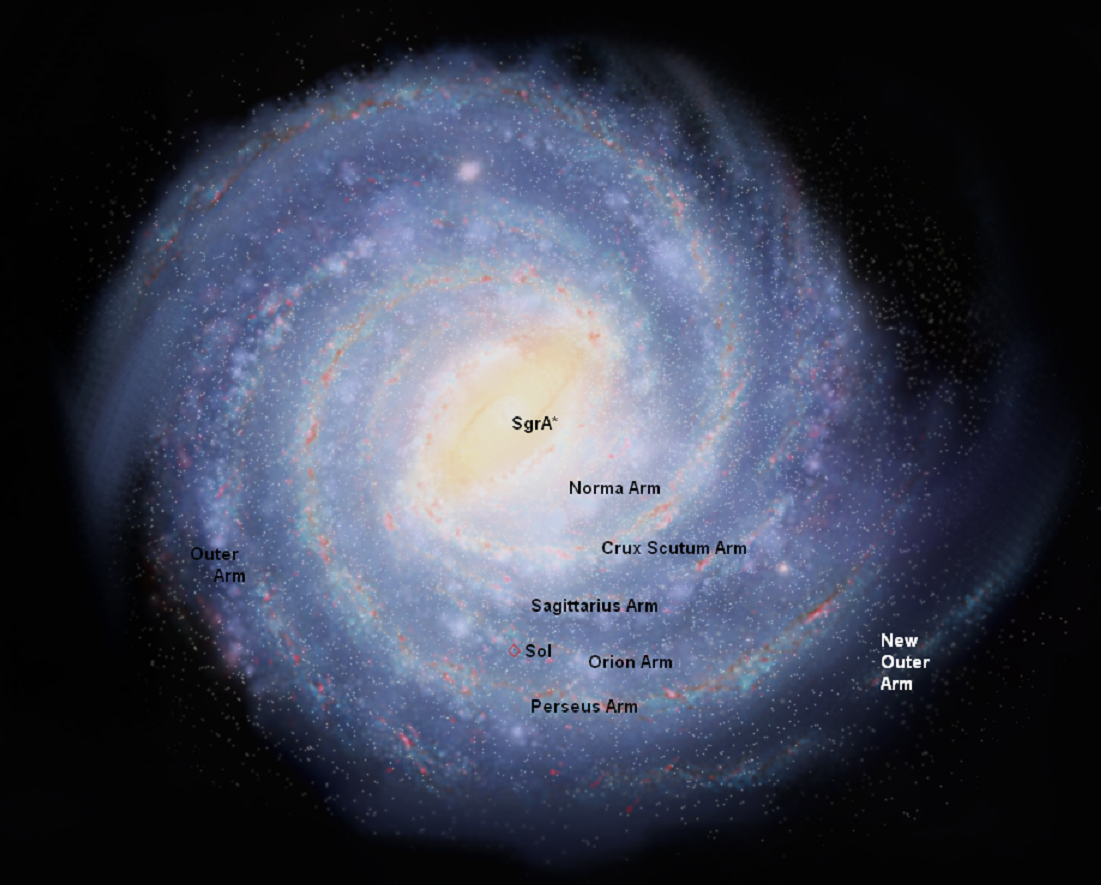
| Map of the Milky Way galaxy, showing the Terragen Sphere alongside other known civilizations in it. |
The Milky Way is the galaxy the Terragen Sphere resides within. It is a barred spiral galaxy with a diameter of around 87,400 light-years, and contains roughly 60 billion stars. It is one of the two large galaxies within the Local Group, alongside the Andromeda galaxy (M31). It is orbited by a number of dwarf galaxies; the most massive of which are the LMC and the SMC.
Table of Contents
1. Structure
2. Population Demographics
Structure
At the centre of the Milky Way is the galactic bulge, a luminous, densely populated volume. The bulge is mostly populated by old stars, with relatively few younger stars. Old red giant stars are common within this region, and their orange-tint starlight dominates the bulge's glow. Embedded within the bulge is the nuclear stellar disc, a flattened disc of stars, which surrounds the nuclear star cluster, a compact and very dense concentration of stars. At the very centre of this region resides Sagittarius A*, a supermassive black hole with a mass of over 4 million times Sol's, generally regarded at the centre of the Milky Way.
The bulge is surrounded by the galactic disc, a flat, warped disc populated by stars, gas, and dust orbiting around the galactic centre in the same direction. The abundance of gas within the disc means most ongoing star formation in the Milky Way occurs within it. As a result, disc stars tend to be younger than elsewhere on average. The Milky Way galactic disc consists of two major components: the older, lower metallicity, vertically-extended thick disc, and the younger, higher metallicity, more flattened thin disc. As a spiral galaxy, the Milky Way's disc features spiral structures, where particularly high concentrations of gas and dust, and especially massive star-forming regions and very young massive stars, can be found. Notable arms include the Orion Arm, which Sol resides within, as well as the Sagittarius Arm and Perseus Arm, located coreward and anti-coreward of Sol, respectively.
Both the bulge and the disc are enveloped by the galactic halo, an extended, tenuous, roughly spherical volume sparsely populated by ancient stars, globular clusters, as well as dark matter, whose mass comprises the majority of the Milky Way's mass.
The Milky Way has accreted many dwarf galaxies and globular clusters over its history, producing numerous streams of stars and other structures and disturbances. One notable object in the process of being accreted is the Sagittarius Dwarf Spheroidal (Sgr dSph) Galaxy, which is being tidally disrupted by the Milky Way, producing a long stream of stars known as the Sagittarius Stream.
Population Demographics
The Milky Way is populated by around 60 billion stars. Around 50 billion among them are fusing stars. Most of this group consists of low mass stars less massive than 1E30 kg (around half Sol's mass), though as the Milky Way experiences ongoing star formation, a significant population of short-lived massive stars also exist. The remaining approximately 10 billion are compact objects, predominantly white dwarfs, with significant fractions of neutron stars and black holes. They are joined by some 20 billion brown dwarfs, hundreds of billions of free-floating planets, and countless interstellar asteroids.
On average, a star or a brown dwarf is accompanied by a number of planetary bodies, including main planets, dwarf planets, and large moons. The total number of such objects in the Milky Way exceeds a trillion.
The Milky Way's relatively high mass allows it to retain 'metals', elements heavier than helium, produced by past generations of stars and explosions of compact objects, enriching gas clouds with such elements. Most stars in the Milky Way are metal-rich as a result, while metal-poor stars are generally few in number, relatively old, and are mostly part of the thick disc or the halo.
Text by AstroChara
from original article by M. Alan Kazlev
Initially published on 08 December 2001.

2025-11-23: Overhauled by AstroChara
1. Added introduction text, Structure, and Population Demographics
Stellar demographics
- The number of stars in the Milky Way is calculated by dividing the total stellar mass of the Milky Way with the average star mass.
-- The total stellar mass of 2.607E10 solar masses is obtained from Lian et al. (2025; https://ui.adsabs.harvard.edu/abs/2025ApJ...990L..37L/abstract). The paper provides separate masses for the fusing stars (as "living stars"), white dwarfs, pulsars, and black holes, as well as the reason why their total stellar mass value is significantly smaller than previous works'.
-- The average star mass is calculated using initial mass function for stars from Kirkpatrick et al. (2024; https://ui.adsabs.harvard.edu/abs/2024ApJS..271...55K/abstract).
--- Stars less massive than 1.2 solar masses are assumed to have the same mass as their formation.
--- Stars more massive than 1.3 solar masses are assumed to have turned into white dwarfs, with current mass found using Full Sample Fit 1 relation from Miller et al. (preprint; https://arxiv.org/abs/2510.24877).
The result is around 55 billion fusing stars, 6 billion white dwarfs, and small number of pulsars and black holes.
- Brown dwarfs: assumed to be between 1/4 and 1/3 as abundant as all stars, yielding around 20 billion.
- Free-floating planets: lower bound of 1.20 ejected planets per star from Guo et al. (preprint; https://arxiv.org/abs/2511.03246); there are likely many more planets smaller than their lower mass bound, and hence the number provided is much larger.
- Planetary bodies bound to stars: Each star is assumed to have more than 10 such objects, considering that the Solar System has around 40. This yields high hundreds of billions; combined with free-floating planets and there may be over a trillion such object.




