
BY LETTER
Orbital (habitat)

Orbiting space habitat | |
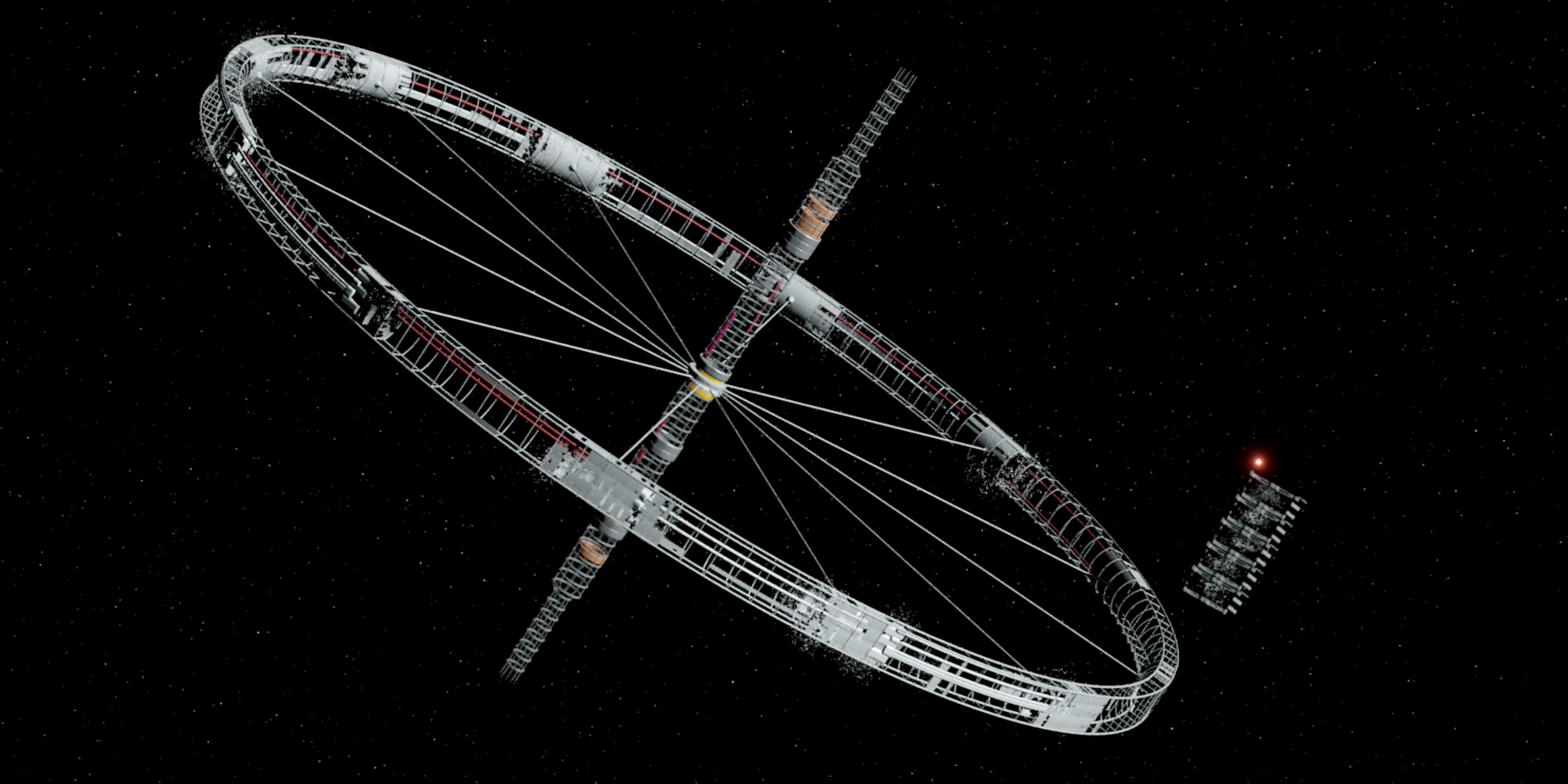 Image from Alex Mulvey | |
| A rotating space habitat under construction | |
Some orbitals occupy low orbits near planets, although these will require regular reboosting in order to maintain their altitude. A popular location for orbital habitats containing medium to large populations is in Clarke Orbit, syncronous with the planet below; a location which can be reached using various elevator technologies. Other common locations for orbital habitats include the Lagrange points of various bodies in the system, and in separate orbital bands far from any perturbation by such objects.
Orbitals come in a vast number of sizes, configurations, and environments, depending on the motivation, tech level, and resources available to their builders. Rotating rings (including Bishop Rings and Banks Orbitals) are preferred for the bigger, megascale orbitals (generally > 100km), rotating cylinders or spheroids (such as McKendree, O'Neill, Bernal, and similar configurations) are common for orbitals from 10 to 10,000 km long, and rotating toruses are used for smaller orbital (around 1 or 2 kilometers in diameter). Spheres and other forms, even irregular shapes, are also used, especially by microgravity clades.
Often the first priority for any new colonisation effort is to build orbital habitats from local materials, and these structures will increase in size, number and complexity as the population increases. In most systems the colonisation of planets and other objects has a much lower priority than the construction of such habitats, which can be built to order with relative ease.
Related Articles
- Hab / Habitat
- Orbital (political unit) - Text by M. Alan Kazlev
Originally, a nation state or city state based on habitats in orbit around Old Earth. Over the course of the Interplanetary Age the term came to be used for any such state in Solsys. By early First Federation times the term Orbital was used more broadly for any independent or semi-independent state based on a hab in orbit around a planet. - Orbital Band
- Rotating Space Habitats
- Singlehabs
Appears in Topics
Development Notes
Text by M. Alan Kazlev
Additional material by Steve Bowers.
Initially published on 17 December 2001.
Orbital image by ATMLVE added 2022
Additional material by Steve Bowers.
Initially published on 17 December 2001.
Orbital image by ATMLVE added 2022






