
BY LETTER
Rak Mesba

Technology > Application > Megascale Engineering
Galactography > Systems and Worlds > Systems & Worlds Q - R
Sophonts > Xenosophonts
Galactography > Systems and Worlds > Systems & Worlds Q - R
Sophonts > Xenosophonts
A xenosophont megastructure in the form of a circumstellar disc | |
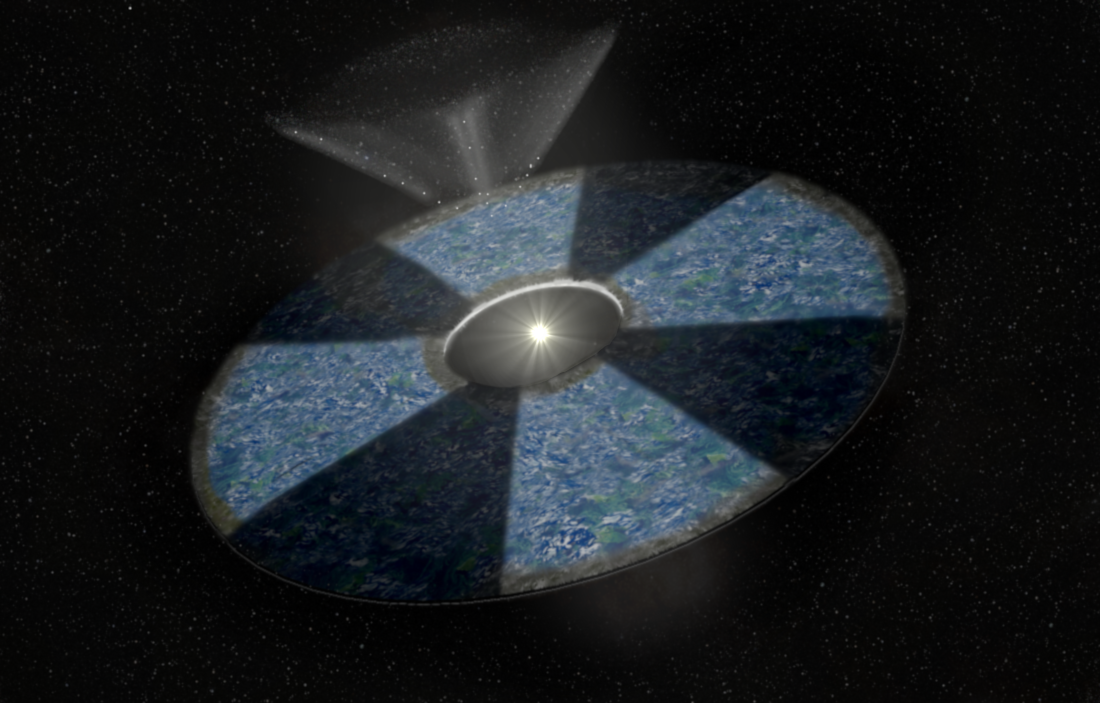 Image from Steve Bowers | |
| Reflective statites above the poles of this star reflect light onto the surface of the disc, emulating a day length of 20.5 hrs. The inner and outer edges of this disk cannot support a biosphere, since gravity is not normal to the surface in these locations; instead these location hold power collection arrays and other infrastructure. | |
Rak Mesba - Data Panel | |
| Star | YTS 8222-0109319 |
|---|---|
| Right Ascension | 11h38m42.2437s |
| Declination | -63d32m00.0468s |
| Distance from Sol | 6317.7311 LY (1.9380 kpc) |
| Absolute Magnitude | 2.60 |
| Apparent magnitude | 14.03 |
| Luminosity | 7.82 x Sol |
| Class | F0 V |
| Surface temperature | 7200 K |
| Radius 1217100 km | (1.77 x Sol) |
| Rotation period | 22.2348 days |
RAK MESBA STRUCTURE | |
| Inner radius | 1.3314 AU |
|---|---|
| Outer radius | 1.9814 AU |
| Thickness | 184.0001 km |
| Mean density | 59048.8342 kg/m^3 |
| Total surface area | 2.6808 e+17 km^2 (5.2558e+8 x Earth) |
| Mass | 2.9127 e+33 kg (1464.4565 solar masses) |
| Surface gravity | 9.1125 meters/sec^2 (0.9292 g) |
| Mean atmospheric pressure | 200.5357 kPa (1.9786 atm) |
| Period of revolution | 222.3532 days |
When the discoverer, a Mawas named Jafri Malin Salleh, found a footnote describing a weakly variable patch in IC 2948 in the archives of the Carina Astrophysical Catalog, his curiosity was piqued. Although the footnote described the observation as probably due to local ionization effects, Salleh felt there was more to the story. Unable to interest the archival staff in his suspicions, he decided to investigate the anomaly himself. Equipping his singleship for an extended voyage, he left Hutan Baru, a Mawas-dominated forward base roughly four hundred thirty light years from IC 2948 and some nine hundred light years from the terminus of the Carina Wormhole, on Kepler 5, 8512. A few hours later, he entered nanostasis after leaving the ship in the care of his AI pilot, Anggun.
On Jung 19, 9083, Anggun awakened Salleh to announce the discovery of a nearby F0V star encircled by a very thin accretion disc a few light-days away; more interestingly, though, was the presence of two slowly blinking light sources at each of the star's poles. Anggun reported that the sources appeared to be at the same distance as the star. Since the star was only a short deviation from their course, Salleh agreed they should investigate further.
Entering what would have been expected to be the outer reaches of the star system, Salleh and Anggun were surprised to find nothing larger than dust grains, and even those were thinly distributed. Telescopic examination revealed the light sources to be arrays of bright objects hovering above and below the star. At higher magnification, the rings resolved into several thousand separate solettas. Each soletta consisted of four circular mirrors, each with a diameter of just under nine kilometers, separated by equal-sized gaps, slowly spinning beneath a thin square of reflective material measuring slightly more than six kilometers on a side. Between the rings of solettas, aligned with the star's equator, was not the expected accretion disc, but a gigantic flattened ring that, rather than being made up of countless small chunks of rock and ice, appeared to be one solid mass. Unlike the well-known "Alderson disk" concept of the late Industrial Age, Rak Mesba is more limited in its extent, occupying only that area around its star where water could exist in its liquid form.
Details of the disc's surface were still, at that distance, lost in the glare of the star and solettas, though a hint of blue haze could occasionally be seen as the disc revolved. As the singleship came closer, the blue haze resolved into an enormous planetscape, complete with land masses, oceans, and swirling spiral cloud formations. Seeing the disc resembled a world, Salleh began many hours of trying to communicate with the flattened ring and who or whatever might be inhabiting it.
Receiving no replies and hearing nothing but static coming from the giant ring, the singleship entered a high parabolic orbit over the megastructure for a closer inspection, though (Salleh hoped) not so close as to worry the disc's inhabitants. The height of the orbit, aside from concerns over the reactions of the disc's residents, was dictated by the fact the Rak Mesba's gravitational field did not obey the inverse-square law, and decreased only slightly at altitudes lower than the outer radius of the megastructure. If no communications were received, Salleh reasoned, the singleship could spiral into a closer orbit. At this point, the plan was to orbit the entirety of the disc to gather a more complete survey of this huge object.
The inner and outer rims of the disc are covered by huge plates composed of a nickel-iron alloy, which serve as a base for a variety of different structures attached to the rims. The four kilometer-wide strip of nickel-iron plates on the inner rim is almost entirely covered by what appear to be photovoltaic arrays. A longer strip of identical width on the outer rim is studded with clusters of what appear to be huge docking cradles, fuel storage tanks, and cargo-handling equipment, punctuated by unlit cavernous bays open to space. A mixture of rock and regolith fills the interior of the disc. Deep scans of the disc's interior revealed a one centimeter thick layer of nickel-iron alloy, identical in composition to the plates covering the inner and outer rims, forming a disc at the center of the megastructure and connecting the inner and outer rims; however, realizing such a structure could not generate the gravitational effects the ship had encountered, Anggun deduced that, unlike the metal plates on the exterior, this interior ring must encase something like a very thin sheet of mag-graphene, woven into a very loose mesh.
The vast spaces between Rak Mesba's rims, a total area of more than 268 quadrillion square kilometers (about 525.6 million times the surface area of Earth), are dotted with rivers, lakes, and oceans (many larger than some planets) on both sides of the megastructure; liquid water covers slightly more than twenty-eight percent of the surface. The remaining area is a mixture of terraced plains, grasslands, marshes, deserts, beaches, snow-capped mountain ranges, and even tundra near the outer rims. Sixteen circular "wells," which appear to connect the two sides of the megastructure, are arranged in a logarithmic spiral pattern extending between the rims. Much of the land surface appears to be covered with various sorts of plant life, though the onboard spectroscope could not identify what chemicals the plants use for photosynthesis. Dotted here and there, mainly along the coasts and along riverbanks are what appear to be sprawling cities, connected by traceries of roads and other transportation pathways. Salleh couldn't be sure, but all of them looked as if they had long ago been abandoned. The surface is illuminated every twenty and one-half hours by a combination of light filtering in from the inner rim and light reflected by the solettas. Darkness, or rather a dim twilight, of about the same length follows when the landscape is below a gap between the mirrors.
Above the landscape, low altitude clouds spiral across the skies of Rak Mesba beneath gossamer streaks of wispy clouds whipped along by the disc's high rate of spin (938.5078 kilometers per second) in an atmosphere composed of nitrogen, oxygen, various oxides of nitrogen, carbon dioxide, methane, and numerous trace gases, with an average surface pressure of almost two atmospheres (slightly higher near the inner rim and slightly lower near the outer rim). The dense atmosphere, along with the relatively rapid revolution of Rak Mesba, transports heat throughout each of the disc's two habitable surfaces. The short "year" and even shorter "day" give Rak Mesba an ever-changing weather, as air warmed by YTS 8222-0109319 and the solettas rises in a moisture-laden high-pressure zone that spreads toward the cooler outer rim, finally ending its high altitude journey, after releasing nearly all of its moisture along the way, above the "cold zone" as a low-pressure cold dry air mass that descends to the surface to begin its return to warmer climes in a gigantic Hadley cell. If the disc were stationary, this would be a simple enough pattern of circulation. But the giant habitat revolves fairly rapidly, and as it does both the sunlit "warm zones" and the darkened "cold zones" are in constant motion. As a result of this radial circulation, coupled with the high velocities imparted by the disc's rotation, the upper levels of Rak Mesba's atmosphere are extraordinarily turbulent, though nearer to the surface calmer conditions prevail. The atmosphere is held in place by ninety kilometer high walls made of huge diamondoid sheets that encircle both the inner and outer rims on each side of the megastructure. These walls each measure two kilometers thick at the base and taper to a thickness of only twenty meters at their summit.
Around both the inner and outer circumferences are a total of ninety-six large turret-like structures arranged in three rows, along the tops of the retaining walls and along the midline of each rim, of sixteen structures per row. Although their actual purpose is unknown at this time, it is believed by some researchers that they are a part of the system which maintains YTS 8222-0109319's position at the exact center of the disc's inner radius. Others have voiced the opinion that these "turrets" may be part of an asteroid defense system (though the two functions are not, it can be argued, mutually exclusive). There are also a number of large coil-like structures located at various locations around the tops of all four retaining walls; at the present time, their function is unknown.
As the singleship was about halfway through its fourth orbit of Rak Mesba, Salleh reported that he had apparently been fired upon by the disc. At that point, he canceled the remainder of his exploration and began his return home. Later inspection of the singleship revealed damage to an aft radiator panel,
apparently caused by a high-energy coherent beam of gamma radiation. The damage sustained, however, was not critical, and the singleship managed to return without further incident. It has been suggested that the vessel may have accidentally been struck by an element of the disk's perturbation control system, though at the present time whether it was accidental cannot be confirmed.
Following the receipt at Hutan Baru of Salleh's initial report in 9513, a great deal of interest in mounting follow-up expeditions to Rak Mesba has been generated, mostly among various corporations and institutes. However, in light of the possibly hostile nature of the artifact and its builders, initial enthusiasm has waned somewhat as considerations of how to defend an expedition from the possibility of attack have entered into preparations for further investigations of Rak Mesba.
When Jafri Malin Salleh returned home on Brahe 8, 9695, he was greeted with great enthusiasm and curiosity from his peers and fellow citizens, and he became something of a local celebrity. His status assured, Salleh has, as of the time of this report, gone on to attract a number of mates as a sign of his social success.
The age of the artifact is unknown, though it appears to be well maintained, as no apparent damage was observed. The nature of its current inhabitants, if any, is similarly unknown. Nor are there any readily apparent clues as to who built it, by what methods, or how long it took to construct. If the builders of Rak Mesba are indeed absent, then their methods and reasons for building the megastructure, and for possibly abandoning it, may never be known.
Related Articles
Appears in Topics
Development Notes
Text by Radtech497
Initially published on 10 December 2010.
Initially published on 10 December 2010.






