
BY LETTER
Fission Drives

Technology > Technology Levels > High Tech / Hitech
Technology > Application > Transportation > Interplanetary Transport
Technology > Application > Transportation > Propulsion Technology
Technology > Application > Transportation > Interplanetary Transport
Technology > Application > Transportation > Propulsion Technology
Propulsion using nuclear fission as a power source |
 Image from Copyright Lilly Harper |
Fission Drives -Data Panel | |
| Summary: | A simple design that must be used with caution because of hazardous exhaust. |
|---|---|
| Basic Propulsion: | Reaction |
| Specific Impulse: | solid core: 500 - 1100 liquid core: 1300 - 1600 gas core: 3000 - 7000 plasma core: 5000-8000 Nuclear-salt-water rocket 67300-482140 |
| Fuel: | Radioactive elements such as Uranium, plutonium and transplutonic elements |
| Reaction Mass: | Usually hydrogen; sometimes water or ammonium |
| Minimum Technology Required: | Middle Tech (Atomic Age Equivalent) |
| Matter Manipulation: | Macroscale |
| Controller required: | Manual / non-sentient computer |
| First Introduced: | Late Information Age. Were used reasonably widely during the early to middle Interplanetary Age |
| Used by: | Vec polities, some Middle Tech systems. |
| Used in: | Low speed interplanetary haulers |
| Construction Costs: | Autofac: high (bulky, requires radioactive elements); Hylonano: cheap assuming presence of component materials |
| Running cost: | Cheap |
| Advantages: | Simple design |
| Disadvantages: | Low isp. Interplanetary only. Exhaust radiation deadly to bionts |
| Normal Acceleration: | 0.1 to 0.2 g or less |
| Drive Details | Fission rockets are thermal rockets that function by heating a working fluid with the thermal output of a nuclear fission reactor. Typically the reaction mass flows directly through solid-core reactors and some liquid-core designs. In the case of gaseous-core fission drives, the heat transfer is by radiation across a transparent, heat resistant ceramic containment vessel. |
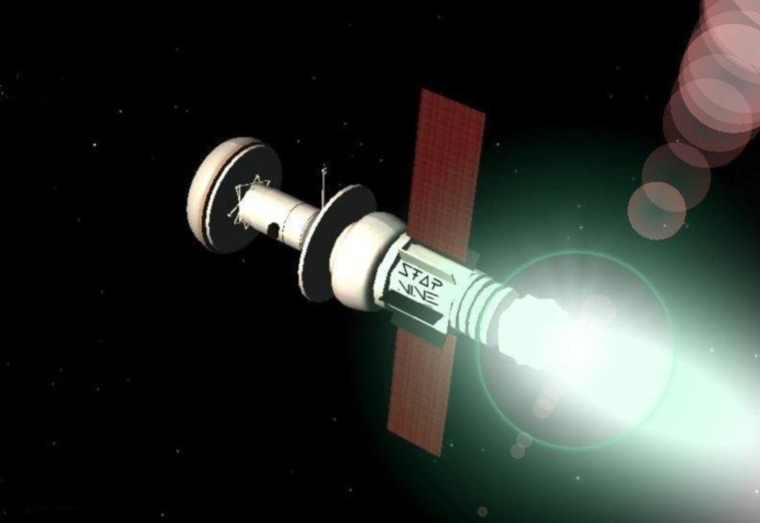 Image from Loopquanta | |
| Star Nine, a fission gas core interplanetary exploration ship from the First Federation era | |
These designs and the external pulse drives are the real workhorses of the S:0 world, assuming a good supply of their rare fuel can be obtained. Fissile and fertile isotopes are very rare in Population 2 stars, but fairly common in Population 1. In very young or very active star-forming regions, many usable isotopes may be common,but in most star systems, only two isotopes are suitable for direct use as fuel (U235 and U238).
Thorium 232 and U238 can be used in breeder reactors to produce usable energy and to breed fissile fuels such as U233, plutonium and trans-plutonic elements.
Hydrogen, water or ammonia are the most commonly used reaction mass with these drives. The performance envelope for these drives is very broad, and almost completely determined by the sophistication of the internal shielding available.
The lowest performance drives use centrifugally contained solid cores, and need relatively little internal shielding as they are relatively cool. Even a solid core fission rocket can occasionally suffer catastrophic failure, where the solid core melts down with disastrous consequences.
Hotter still are the liquid core designs, usually but not always centrifugally stabilized. In liquid-core designs, the temperature of the fuel increases until it melts. The most common fuel composition is a uranium-iron alloy, U6Fe, which has a very high vapor pressure and boiling point but a fairly low melting point. Liquid core designs use high temperature "normal" or nano materials such as early diamondoid as the containment, actively cooled by blowing reaction mass through the containment.
Even hotter are the gas core designs, in which the fuel is in the form of a gas, usually uranium fluoride of various compositions such as the U, F, UF4, UF6 family. Chlorine and thorium can also be used with similar performance and chemistries. Such designs are also usually centrifugally stabilized, with complex counterflow gas currents in the core. The Nuclear Lightbulb design uses quartz to contain the gaseous reaction in a closed cycle, while passing heat to the propellant rapidly. In other designs, the containment was usually diamondoid in a porous structure, actively cooled by blown reaction mass. This type of active cooling is more effective in a gas core design due to the single-phase gaseous core. In more modern designs, the diamondoid is usually supplemented by reflective programmable matter layers. Some gas core designs also use electromagnetic shielding to supplement the diamondoid/programmable matter vessel.
Hotter still are fission plasma core designs, in which the gaseous core becomes hot enough to partially or fully ionize the gas to a plasma, and the use of electromagnetic shielding becomes essential rather than an addition. Plasma core fission drives are the distant ancestors of the much more potent Monopole Catalyzed Conversion Drive, and the work on containment vessels done for these plasma-core devices is critical for early Conversion Drives, as well. Such drives use a complex multi-layer design of electromagnetically cooled plasma, a blown-in gas layer (usually the reaction mass) and a diamondoid/programmable matter last wall.
Nuclear-salt-water rockets produce a plasma-hot exhaust by mixing fissile materials dissolved as salts in water; a continuously detonating fisson explosion results, and the water is vaporised and becomes a propellant as well as a heat dump. These fission rockets have both high thrust and high exhaust velocity, but are very difficult to control reliably. NSWRs were developed comparatively late in the Interplanetary Age, by which time many different kinds of fusion rockets were already available, so they were never very common in that era. In later eras hi-tech NSWRs have been used in a number of locations, especially where fissile elements are plentiful.
Internal fission drives have Isps ranging from 800 seconds for a simple solid core design to 8000 seconds for an advanced plasma core design. The thrust to weight ratio ranges from 10 to 1 to 100 to 1, and the total delta-v varies from 20 km/sec to over 100 km/sec.
NSWRs act as continuously operating external fission drives, and advanced designs can reach 482140 seconds.
Related Articles
- Antimatter Catalysed Fusion
- Antimatter Propulsion
- Chemical Rockets
- Fusion Plasma Rockets
- Nuclear Fission - Text by M. Alan Kazlev
The process whereby the nucleus of an unstable (radioactive) heavy element spontaneously splits into two smaller nuclei, releasing energy and charged particles. - Nuclear Pulse Drives
- Rocket Performance
Appears in Topics
Development Notes
Text by Mauk Mcamuk, Chris Shaeffer and M. Alan Kazlev
Amendments by Mike Miller and Steve Bowers
Initially published on 03 December 2008.
Amendments by Mike Miller and Steve Bowers
Initially published on 03 December 2008.
Additional Information
Image 'Fission Drive' copyright by Lilly Harper used with permission. Please contact her for conditions of re-use at https://beaconsinthedark.wordpress.com/.






